When you think about human bones, you might picture dry, brittle structures gathering dust in a science classroom. But the reality is far more fascinating: your bones are dynamic, living organs that rebuild themselves constantly, communicate with other body systems, and perform functions you’ve probably never imagined.
More Than Just a Scaffold
Yes, bones provide structural support—but that’s just the beginning. Your skeletal system is a biological marvel that performs at least six critical functions simultaneously:
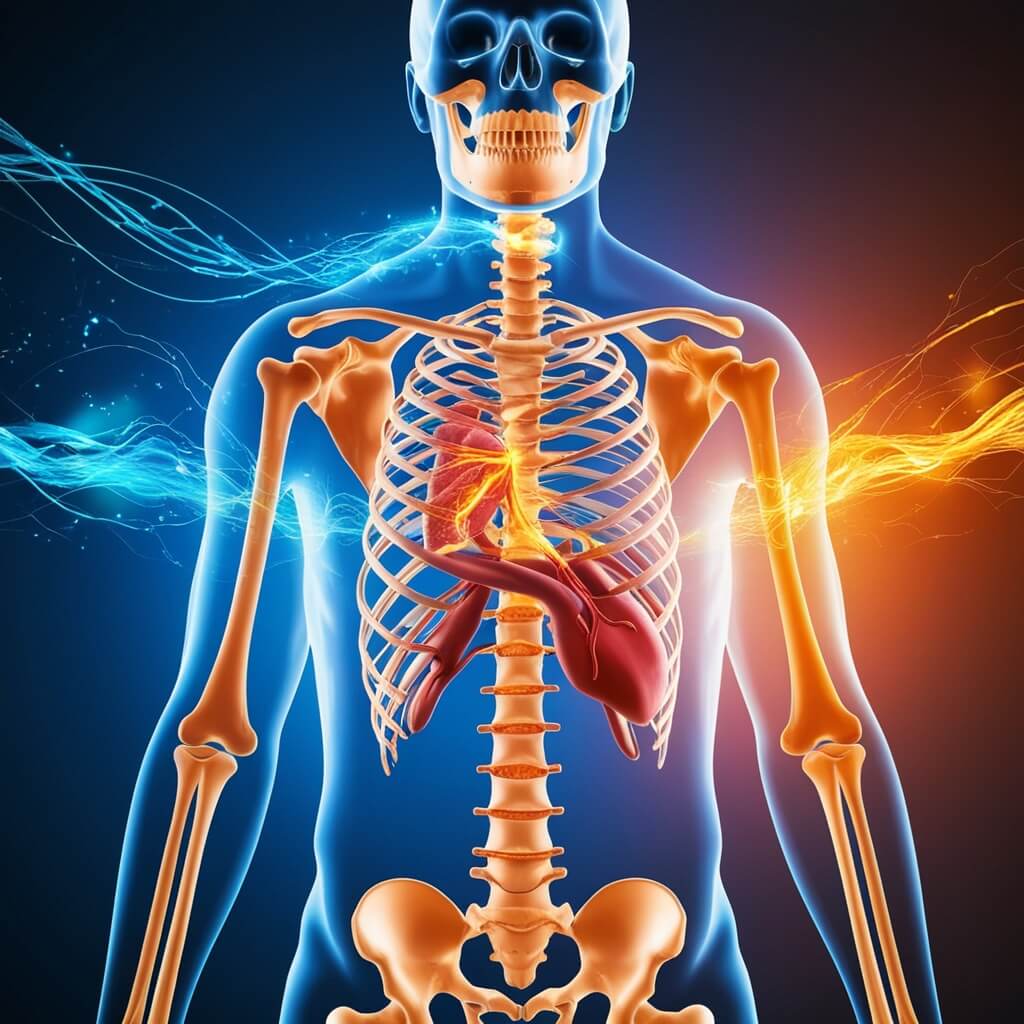
Structural Support & Protection: Your 206 bones create a framework that maintains body shape and shields vital organs. The skull protects your brain, the rib cage guards your heart and lungs, and your vertebrae safeguard the delicate spinal cord.
Movement Facilitation: Bones work as lever systems. When muscles contract, they pull on bones to create movement. Without this rigid framework, your muscles would be as useful as rubber bands floating in gelatin.
Mineral Storage: Bones serve as your body’s mineral bank, storing 99% of your calcium and 85% of your phosphorus. When blood calcium drops, bones release it. When levels rise, bones deposit it back. This constant exchange keeps your nerves firing, muscles contracting, and heart beating properly.
Blood Cell Production: Inside the spongy tissue of certain bones lies red bone marrow—a blood cell factory producing approximately 2 million red blood cells every second. That’s 200 billion per day, along with white blood cells and platelets.
Fat Storage: Yellow bone marrow stores energy in the form of adipose tissue, serving as a critical energy reserve.
Endocrine Function: Recent discoveries reveal bones produce hormones like osteocalcin, which influences blood sugar regulation and male fertility. Your skeleton is literally an endocrine organ!
The Hidden Complexity: Human Bone Anatomy
Look closer at a bone and you’ll find an engineering masterpiece. Bone tissue exists in two forms:
Compact (Cortical) Bone forms the dense outer layer—80% of your skeletal mass. Under a microscope, you’d see cylindrical structures called osteons, each containing concentric rings of mineralized matrix surrounding tiny blood vessels. This design provides incredible strength while maintaining relative lightness.
Spongy (Trabecular) Bone fills the interior with a honeycomb-like network of tiny struts called trabeculae. This seemingly delicate structure is strategically arranged along stress lines, maximizing strength while minimizing weight—a principle engineers have only recently begun to replicate in building design.
The Living Bone: A Constant Renovation Project
Here’s something remarkable: your skeleton completely replaces itself approximately every 10 years through a process called bone remodeling. Specialized cells work in coordinated teams:
Osteoclasts are the demolition crew, dissolving old or damaged bone tissue by secreting acids and enzymes.
Osteoblasts are the construction workers, building new bone matrix and depositing minerals.
Osteocytes are mature bone cells embedded within the matrix, acting as mechanical sensors that detect stress and coordinate the remodeling process.
This renovation happens constantly—adults remodel about 10% of their skeleton annually. When you’re young, bone formation outpaces breakdown, increasing bone mass. Peak bone mass occurs around age 30. After that, breakdown gradually exceeds formation, which is why maintaining bone health becomes crucial as we age.
The Strongest Bone vs. The Smallest: Fascinating Facts
The femur (thighbone) is the longest and strongest bone in your body, capable of withstanding forces of 1,800 to 2,500 pounds—more than the weight of a small car. Its strength comes from its cylindrical shape and the dense arrangement of compact bone.
The stapes in your middle ear is the smallest bone, measuring just 2-3 millimeters. Despite its size, it’s essential for hearing, transmitting sound vibrations from the eardrum to the inner ear.
The hyoid bone in your neck is the only bone that doesn’t connect to any other bone—it’s suspended by ligaments and muscles, allowing the complex movements necessary for swallowing and speech.
When Human Bones Break: The Healing Miracle
Bone fractures trigger an extraordinary healing cascade. Within hours, blood clots form at the break site. Inflammatory cells arrive to clear debris. Within days, a soft callus of cartilage bridges the gap. Over weeks, this transforms into a hard bony callus—often stronger than the original bone. Finally, over months, remodeling reshapes the repair site until the fracture is nearly invisible.
This regenerative capacity is unique among hard tissues—cartilage, for instance, heals poorly by comparison.
Keeping Your Bones Strong: Evidence-Based Strategies
Bone health isn’t passive—it requires active maintenance:
Weight-bearing exercise stimulates bone formation. When bones experience mechanical stress, osteocytes signal osteoblasts to build more bone. Activities like walking, running, dancing, and resistance training are particularly effective.
Calcium and Vitamin D are the building blocks. Adults need 1,000-1,200 mg of calcium daily and at least 600-800 IU of vitamin D. But don’t overdo it—excessive calcium supplementation may have cardiovascular risks.
Protein matters more than many realize. Bone matrix is about 50% protein by volume, and adequate protein intake (0.8-1.0 g/kg body weight) supports bone health.
Avoid bone thieves: Excessive alcohol, smoking, and prolonged corticosteroid use all accelerate bone loss.
The Bone-Body Connection
Modern research reveals surprising connections between bones and other systems:
- Human Bones influence metabolism through osteocalcin, affecting blood sugar and fat storage
- The skeleton communicates with muscles through biochemical signaling, coordinating strength and function
- Bone marrow produces immune cells, making your skeleton part of your immune system
- Bone health correlates with brain health—some studies suggest osteoporosis may increase dementia risk
The Future of Human Bone Science
Exciting developments are on the horizon:
3D-printed bone scaffolds may soon replace traditional bone grafts, custom-designed for each patient.
Stem cell therapies show promise for regenerating damaged bone tissue.
Biological bone cement incorporating growth factors could accelerate healing in fractures and fusions.
Pharmacological advances are developing drugs that build bone more effectively with fewer side effects than current osteoporosis medications.
Conclusion: Respect Your Remarkable Skeleton
Your bones are not inert structures—they’re living, breathing, constantly adapting organs that deserve care and attention. They respond to how you move, what you eat, and how you live. Every step you take, every weight you lift, every nutrient you consume sends signals to your skeleton.
The 206 bones in your body aren’t just holding you up—they’re protecting you, nourishing you, moving you, and even thinking (biochemically) about your metabolic needs. That’s not just structure; that’s intelligent design by evolution.
So the next time you’re tempted to skip that walk or pass on those leafy greens, remember: your bones are listening, adapting, and responding. Treat them well, and they’ll support you for a lifetime.
Have questions about bone health or experiencing concerns about your skeletal system? Always consult with a healthcare professional for personalized medical advice.